Thinking about AI in 2025, it feels like we’re all trying to figure out what’s what. It’s everywhere, from how students learn to how jobs are done. But is AI hard to study? That’s the big question. It seems like the more we use it, the more complex things get.
We’re seeing AI pop up in schools, in workplaces, and even in how we think about what it means to be human. Let’s break down what all this means.
Key Takeaways
- Students are using AI a lot for schoolwork, with many saying it helps them understand things better and saves time, though institutions aren’t always providing much support for learning these skills.
- The value of just knowing facts is dropping because AI can access so much information. This means people need to focus more on skills like judgment and creativity, which AI can’t easily replicate.
- The job market is changing fast due to AI. Many new jobs will require working with AI tools, and skills like digital literacy are becoming super important to keep up.
- Learning how to effectively talk to AI, known as prompt engineering, is becoming a skill in itself, but it’s not straightforward and requires careful thought to get the best results.
- AI is changing jobs by helping people do more, rather than just replacing them. The focus is shifting towards human judgment and the ability to work alongside machines to create new value.
The Pervasive Integration Of AI In Student Life

It’s pretty wild how quickly AI has become a regular part of student life, almost without us really noticing. Think about it – from high school essays to college research papers, AI tools are showing up everywhere. A recent survey from the UK think tank HEPI really hammered this home.
They found that a whopping 92% of university students are now using AI, a huge jump from the year before. And it’s not just for brainstorming; 88% are using generative AI for actual assignments, up from just over half.
Students say it helps them understand tough topics, summarize readings, and even get new research ideas. Plus, they feel it saves them time and makes their work better.
Student Generative AI Survey Findings
This survey also highlighted some interesting points. While many students find AI helpful, there’s a bit of a gender difference. Women in the survey reported worrying more about being accused of academic misconduct or getting biased results from AI.
It also seems like schools aren’t quite keeping up with this rapid adoption. Only about 36% of students said they’ve actually received any support from their university to learn how to use these AI skills properly. That’s a pretty big gap.
Institutional Support For AI Skills
Colleges and universities are starting to figure out how to deal with this. Some are looking at ways to introduce AI to first-year students and teachers, covering the basics of how AI works and how to write good prompts.
They’re also trying to figure out what students and teachers already know about AI by surveying them. There are even open educational resources popping up to help people get up to speed.
Early Childhood AI Exposure
And it’s not just older students. Even very young kids are getting exposed to AI. A big study called the 2025 Common Sense Census showed that by age 8, almost a quarter of children have their own cellphones. Gaming time has shot up, and about 29% of these young kids are using AI for school stuff.
Interestingly, many parents don’t think this AI use has really changed their child’s understanding of schoolwork or their creativity. It’s a complex picture, with AI becoming a tool for some, while others are still figuring out its place.
The speed at which AI is weaving itself into the fabric of education is undeniable. From explaining complex concepts to assisting with assignments, students are increasingly turning to these tools. However, the support systems and understanding of AI’s implications within academic institutions are still catching up to this rapid integration.
Redefining Expertise In The Age Of AI
It feels like just yesterday, having a lot of knowledge was the main ticket to getting ahead. You got your degree, you collected experience, and that was your identity, right? “I am what I know.” But AI is really shaking that up.
It’s like we’re going through a massive knowledge inflation, where knowing more stuff just doesn’t carry the same weight it used to. AI can pull up all of human knowledge in seconds, and honestly, it’s pretty good at putting it together. So, what does that mean for us?
The Meaning-Making Paradox
This is where things get interesting. AI can spit out facts and figures, and even write pretty convincing text, but it doesn’t understand in the way we do. It can’t really grasp the ‘why’ behind things or connect dots in a way that feels human. Think about a radiologist.
An AI might be able to spot a tumor on a scan with incredible accuracy, maybe even better than a human. But the job isn’t just about reading scans. It’s about the whole package: taking responsibility, explaining things to a scared patient, and being part of a team. When the AI messes up, who’s on the hook? It’s not just about the technical skill anymore.
The Collapsing Currency Of Knowledge
We’re seeing a real shift. The value isn’t just in knowing things anymore; it’s in what you do with that knowledge. It’s about judgment. For example, financial markets have these “circuit breakers.” Even though algorithms do most of the trading, humans have to step in and stop things when the market goes haywire.
They don’t trade; they decide when to pause the machines. This is because pure automation misses the bigger picture. Organizations that just try to automate tasks often fail because they don’t account for the messy, human parts of work.
Cultivating Human-Centric Skills
So, if knowing everything isn’t the goal, what is? It’s about skills that AI can’t easily replicate. Things like:
- Judgment: Knowing what to build or what path to take when there are endless possibilities.
- Agency: Being able to set your own goals and steer your own ship, even when AI is doing the heavy lifting.
- Learning Velocity: How fast you can adapt and pick up new things, rather than just accumulating old knowledge.
- Taste: Having a sense of what’s good or important, which comes from experience and isn’t easily programmed.
The real premium is now on knowing how to work with AI, not just about it. It’s about using AI as a tool to amplify what makes us uniquely human – our ability to connect, to judge, and to make sense of the world.
The old way of thinking about jobs as just a collection of skills is falling apart. AI is forcing us to look at work as a whole system, and that’s where human value really shines through. It’s not about competing with machines on knowledge; it’s about partnering with them to do things we couldn’t do before.
Navigating The AI Skills Revolution
It feels like every other day there’s a new headline about AI changing the job market. And honestly, it’s a lot to take in. We’re seeing a big shift, not just in what jobs exist, but in what skills actually matter. It’s less about knowing a ton of facts and more about how you use that knowledge, or even when to ignore it.
Global AI Skills And Workforce Impacts
Lots of reports are coming out about this. One study found that most people think AI will actually make human skills more important, not less. It’s supposed to help us focus on the bigger picture stuff, like planning and figuring out tough problems.
There are differences, though. Some parts of the world seem more confident about using AI for complex tasks than others.
- AI is expected to create millions of new jobs by 2030, but also eliminate millions more.
- Many of these new roles will involve using AI as a tool, not being replaced by it.
- Organizations are starting to see that while AI can automate tasks, human judgment is still really hard to replace.
AI’s Role In Mitigating Skills Shortages
Companies are worried about not having enough people with the right skills. A lot of them are looking at AI as a way to help fill those gaps. Think about it: AI can handle a lot of the repetitive, time-consuming work.
This frees up people to do the more complex, creative, or strategic parts of their jobs. It’s not just about replacing people, but about making the whole system work better.
The idea that AI will just take over everything is a bit of a miscalculation. Many companies that focused only on automating tasks, rather than looking at the whole job system, have run into problems. They replaced skills, not judgment, and it didn’t work out as planned.
The Rise Of Digital And AI Literacy
So, what does this mean for us? We need to get better at understanding and using these new tools. It’s not just for tech people anymore. Everyone needs a basic level of digital and AI literacy. This means knowing how to interact with AI, understand its outputs, and recognize its limitations. It’s becoming as important as reading and writing was a generation ago.
Here’s a quick look at what’s needed:
- Understanding AI Basics: Knowing what AI is, what it can do, and what it can’t.
- Effective Interaction: Learning how to prompt AI and interpret its responses.
- Critical Evaluation: Being able to spot AI errors or biases and knowing when human oversight is necessary.
- Adaptability: Being open to learning new AI tools as they emerge and change.
The Evolving Landscape Of AI Education
Global AI Education Strategies
Countries are really starting to think about how to get AI into schools. It’s not just about teaching kids to code anymore. Estonia, for example, is working with OpenAI to bring ChatGPT Edu to their secondary schools. They’re already big users of ChatGPT, so this feels like a natural next step for them.
Then there’s the European Commission, which is putting together a list of how different organizations are teaching people about AI. They’re trying to make sure everyone understands AI, especially with new rules coming out.
It’s interesting to see how different places are approaching this. Some are focusing on training teachers, others on creating resources for students.
The goal seems to be making sure people can actually use AI tools and understand what they do, not just play around with them. This global push highlights a growing recognition that AI literacy is becoming as important as reading or math.
AI Literacy Initiatives In Schools
Schools are starting to get serious about AI literacy. We’re seeing programs pop up everywhere. Hartford Public Schools in Connecticut had a special learning group for teachers to help them get up to speed on AI.
Stanford University is also updating its free AI lessons for high schoolers, with topics like “AI or not AI?” which sounds pretty fun. They even have lessons about whether AI can help us talk to whales! It shows they’re trying to make learning about AI engaging and relevant.
Some schools are even looking at how young kids are interacting with AI. A recent report showed that kids as young as eight are using AI for schoolwork, though parents aren’t always sure if it’s helping them learn. It’s a tricky balance, trying to introduce these tools without letting them replace actual learning.
Partnerships For AI Research And Development
Big players in AI are teaming up with universities to push research forward. OpenAI, for instance, is giving money and resources to 15 major universities like Harvard and MIT through their NextGenAI program.
They want students and teachers to work on new AI ideas. This kind of partnership is key because it brings together the people who build the AI with the people who are trying to understand how it works and how we can use it better.
It’s not just about the tech companies though. Libraries are getting involved too. The LIBRA.I. project is working with public libraries in Europe to teach people about AI and media literacy.
They’re even creating a guide in five languages. This shows that AI education isn’t just for computer science majors; it’s for everyone, and partnerships are helping to spread the word.
The Nuances Of Prompt Engineering
So, you’ve got these AI tools, right? They can write, code, even whip up images. But getting them to do exactly what you want? That’s where prompt engineering comes in. It sounds fancy, but really, it’s just about talking to the AI in a way it understands best. It’s not as simple as just asking a question.
Prompting Approaches And Performance
Different ways of asking can lead to wildly different results. Think of it like giving directions. “Go that way” is pretty useless. But “Turn left at the next traffic light, then go two blocks and it’s the third house on your right”? Much better. The same applies to AI.
Being specific, giving context, and even telling the AI what not to do can make a huge difference in the output you get. Some studies show that just rephrasing a prompt can change the AI’s answer significantly.
Benchmarking AI Performance
How do we even know if one AI is better than another, or if our prompts are any good? That’s where benchmarking comes in. It’s like giving a bunch of students the same test to see who scored highest. But with AI, it’s tricky. What’s a “good” answer? Is it the most creative? The most accurate? The fastest? There’s no single test that works for everything. We need different tests for different jobs.
Here’s a quick look at why judging AI performance isn’t straightforward:
- Task Specificity: An AI great at writing poems might be terrible at writing code.
- Metric Choice: Do we care more about speed, accuracy, or originality?
- Human Evaluation: Often, a human still needs to decide if the AI’s answer is actually useful.
The Complexity Of Effective Prompting
It turns out, making AI do what you want isn’t just about knowing the right keywords. It’s about understanding how the AI
AI’s Impact On Professional Roles

It’s getting pretty wild out there for jobs, isn’t it? We’re seeing AI pop up everywhere, and it’s making people wonder what their own role will be. Some folks are worried about being replaced, but it seems like the bigger picture is more about how jobs will change, not disappear entirely. Think of it less like a robot taking over and more like getting a super-powered assistant.
AI Augmentation Versus Replacement
Most experts aren’t predicting a massive wave of job losses due to AI. Instead, the trend points towards AI augmenting what people do. This means AI handles the repetitive, data-heavy tasks, freeing up humans for more complex thinking.
For instance, a recent study found that a huge majority of workers believe AI will actually boost human creativity and let them focus on bigger-picture stuff like strategy and problem-solving. It’s not about AI doing the job, but about AI helping you do your job better and faster.
The Value Of Human Judgment
Even with AI getting smarter, there are things it just can’t replicate. Human judgment remains incredibly important. Think about situations with a lot of gray areas, ethical dilemmas, or when you need to understand the emotional impact of a decision.
AI can crunch numbers, but it can’t quite grasp the nuances of human experience or provide that moral compass. When an AI makes a mistake, especially one with serious consequences, there’s still a need for human accountability and oversight.
The Shifting Nature Of Work
So, what does this mean for the future? Jobs are evolving. We’re moving away from just accumulating knowledge to applying it in smarter ways. The skills that are becoming more valuable aren’t just technical; they’re about how we interact with AI and with each other.
Here are some of the qualities that seem to be gaining importance:
- Taste: Knowing what to create or build when AI can generate endless options. It’s about making choices based on accumulated judgment.
- Extreme Agency: Taking ownership and knowing what needs to be done, even without constant direction. This is about setting goals and correcting course.
- Learning Velocity: Being able to adapt and learn quickly as new AI tools and knowledge emerge. It’s about staying ahead of the curve.
- Interruptibility: Knowing when to step in and stop a process, especially when an AI might be heading in the wrong direction in a way that’s hard to measure.
The core idea is that as AI takes on more of the ‘knowing,’ humans will be valued more for their ‘doing’ and ‘being’ – their ability to connect, judge, and create meaning. This shift is less about competing with machines and more about partnering with them to achieve new outcomes.
It’s a big change, for sure. But it also means that human skills, the ones that make us uniquely human, are likely to become even more prized in the years to come. It’s not about being replaced, but about redefining what makes us valuable in a world where machines can know so much.
The Existential Questions AI Poses
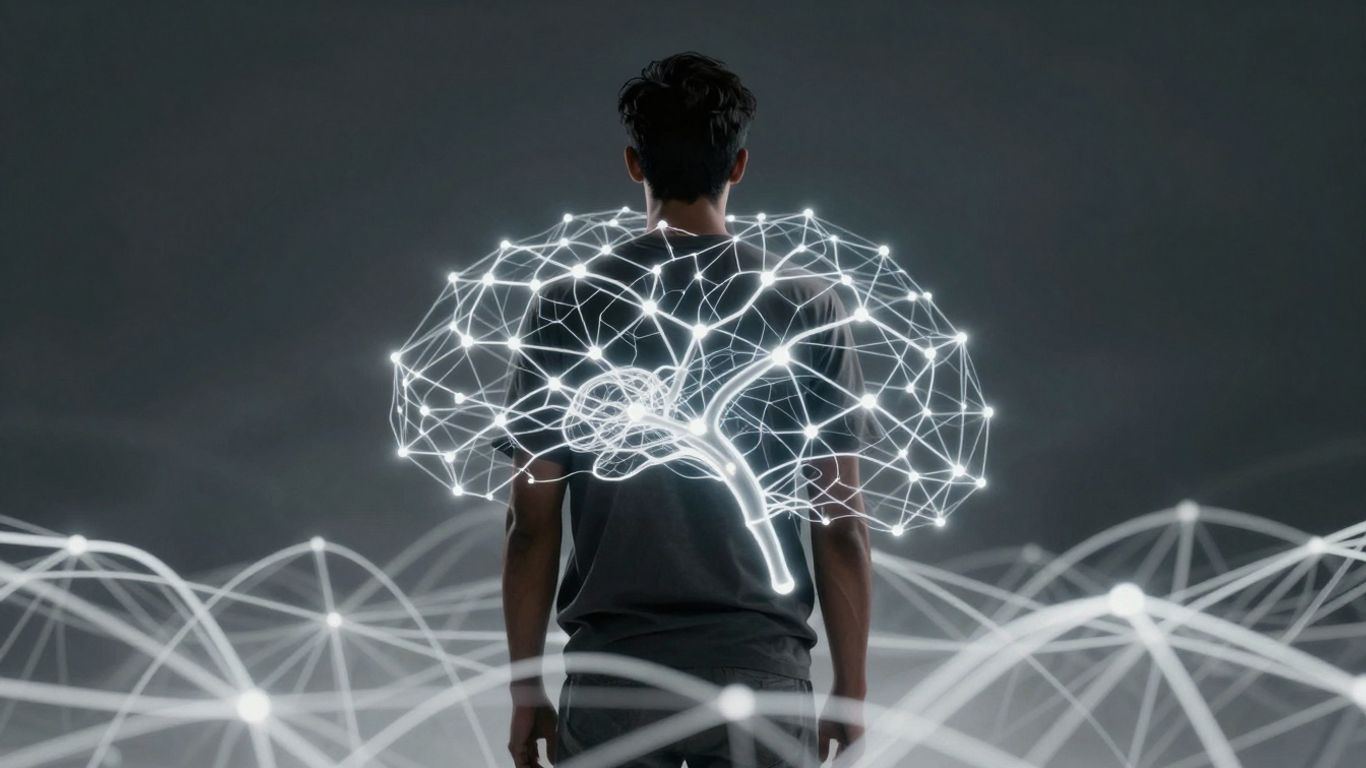
So, we’ve got AI doing all sorts of things now, right? It can write, it can code, it can even make art. But as it gets better and better, it starts to make us think about some pretty big stuff. It’s not just about jobs anymore; it’s about what it means to be human.
Ownership and Liability in AI Errors
When an AI messes up, who’s on the hook? If a self-driving car causes an accident, is it the programmer, the owner, or the AI itself? This isn’t a simple question. AI systems are complex, and tracing blame can get messy. We’re used to people being responsible for their actions, but AI doesn’t have feelings or intentions in the human sense. It’s a thorny issue that legal systems are just starting to grapple with.
The Human Element in Meaning-Making
AI can process vast amounts of information and even generate text that sounds meaningful. Think about reading a book versus just getting a summary. The summary tells you what happened, but the experience of reading the book changes you.
AI can simulate understanding, but it doesn’t experience things. Work isn’t just about tasks; it’s about the significance we find in what we do. Can AI truly create meaning, or just mimic it? That’s a big question for how we define work itself.
Identifying Irreplaceable Human Capacities
As AI takes over more tasks, we’re forced to look at what humans do that machines can’t. It’s not just about knowing more facts – AI is great at that. It’s more about things like:
- Judgment: Knowing what problems are worth solving, not just how to solve them.
- Connection: Building relationships and understanding people on a deeper level.
- Creativity: Coming up with truly novel ideas, not just variations on existing ones.
- Adaptability: Quickly learning and adjusting to new, unexpected situations.
The shift is moving away from simply accumulating knowledge, which AI can do at an incredible speed. Instead, value is concentrating in our ability to apply that knowledge with wisdom, to make choices based on context and experience, and to connect with others in ways that AI cannot replicate. This redefines what makes us valuable in the professional world and beyond.
It feels like we’re being pushed to figure out what makes us uniquely human, and honestly, that’s a pretty profound challenge.
The Future Of Work And Human Value
So, what’s left for us humans when AI can crunch numbers and write reports faster than we ever could? It’s a question on a lot of minds, and honestly, it’s not about AI replacing us. It’s more about what AI forces us to see about our own work.
From Knowledge Accumulation To Judgment
Think about it: for ages, we’ve valued people for what they know. Degrees, certifications, years of experience – these were the markers. But AI is changing that game. It has access to pretty much all human knowledge, instantly. This means just knowing stuff isn’t as special as it used to be.
The real value is shifting towards judgment. It’s about knowing which information matters, when to trust an AI’s output, and when to question it. It’s the difference between having a massive library and knowing which book to pull off the shelf for a specific problem.
The Critical Role Of Human Circuit Breakers
AI can be incredibly powerful, but it’s not perfect. Sometimes, it makes mistakes. Sometimes, it goes down a path that doesn’t make sense in the real world. That’s where we come in. We’re the ones who can act as ‘circuit breakers.’
We can spot when an AI is heading for trouble, when its logic is flawed, or when its output is just plain wrong for a specific situation. This isn’t about being smarter than the AI; it’s about having that human perspective, that gut feeling, that ability to see the bigger picture that an algorithm might miss.
Partnering With Machines For New Value
Instead of seeing AI as a competitor, we should think of it as a partner. Many jobs aren’t going to disappear; they’re going to change. Think about how AI can handle the repetitive tasks, freeing us up for the more complex, creative, and human-centric parts of our work.
For example, AI can analyze medical scans with incredible accuracy, but a human doctor is still needed to talk to the patient, understand their fears, and make the final call. This partnership creates a new kind of value, one that combines the speed and data-processing power of AI with the empathy, creativity, and judgment of humans.
Here’s a quick look at how this partnership is playing out:
- Augmented Roles: Many jobs will see AI as a tool that makes workers more effective, not obsolete. Think lawyers using AI for research or designers using AI for initial drafts.
- New Job Creation: As AI develops, new roles will emerge focused on managing, refining, and ethically deploying AI systems.
- Focus on Human Skills: Abilities like communication, critical thinking, emotional intelligence, and problem-solving will become even more important as they are harder for AI to replicate.
The real challenge isn’t about competing with AI on its terms. It’s about understanding what makes us uniquely human and finding ways to integrate those qualities with the capabilities of AI to create something better than either could achieve alone. This shift requires us to rethink not just our skills, but our very definition of work and value.
So, Is AI Hard to Study in 2025?
Looking at everything, it’s clear that figuring out AI isn’t a simple task. Students are using it a ton, way more than before, for everything from homework help to research. But schools aren’t really keeping up with teaching people how to use it right.
Plus, there’s this whole other layer with AI getting better so fast, making old skills less useful and pushing us to think about what makes us human in the first place.
It’s not just about knowing stuff anymore; it’s about how we connect ideas, make choices, and figure out what problems are actually worth solving. So yeah, studying AI in 2025 is definitely a challenge, but maybe it’s also a chance to really understand what we bring to the table that machines can’t.
Frequently Asked Questions
Are students using AI a lot in school?
Yes, a huge number of students are using AI tools for their schoolwork. A recent survey showed that most students use AI to help them understand difficult topics, shorten long texts, and come up with ideas for their projects. It seems to help them save time and make their work better.
Do schools teach students how to use AI?
Not really, at least not yet. The same survey found that only a small portion of students felt their school gave them help to learn how to use AI skills. This means many students are figuring it out on their own.
Is knowing a lot of facts still important with AI?
It’s becoming less important. AI can quickly access and process tons of information. What’s becoming more valuable is what you *do* with that information – like making smart choices, understanding situations, and coming up with new ideas. It’s more about using your brain to figure things out than just remembering facts.
What are ‘prompt engineering’ skills?
Prompt engineering is like learning how to talk to AI to get the best results. It’s about figuring out the right words and instructions to give the AI so it understands exactly what you want and gives you a helpful answer. It’s not as simple as just asking a question; it takes some skill to do it well.
Will AI take away jobs?
It’s complicated. AI will likely change jobs a lot. Some tasks might be done by AI, but it also means new jobs will be created, especially those that involve working *with* AI. The most important thing will be to have skills that AI can’t easily copy, like creativity, critical thinking, and good judgment.
What does AI mean for the future of work and people’s value?
AI is making us think about what makes humans special. Instead of just being good at knowing things, our value will come from our ability to make decisions, connect with others, be creative, and understand what’s truly important. It’s about working together with AI, using our unique human skills to do even better.