Artificial Intelligence, or AI, is everywhere these days, from the phones in our pockets to the cars on the road. It feels like magic sometimes, but it’s really just smart computer programs. But not all AI is the same. There are different kinds, and knowing them helps us understand what AI can and can’t do. So, what are the 4 types of AI? Let’s break it down in simple terms.
Key Takeaways
- Narrow AI is built for one specific job, like playing chess or recommending movies.
- General AI, which doesn’t exist yet, would be able to do any intellectual task a human can.
- Reactive machines simply react to what’s happening now, with no memory of the past.
- Limited Memory AI uses past data to make better decisions, like virtual assistants learning your preferences.
- Theory of Mind AI aims to understand human emotions and intentions, a big step towards more human-like interaction.
Narrow Or Weak AI

So, let’s talk about the AI we actually see all around us right now. This is called Narrow AI, or sometimes Weak AI. It’s designed to do one specific job, and it does that job really well. Think of it like a super-specialized tool.
It can’t suddenly decide to learn how to play chess if it was built to sort emails, and it certainly can’t ponder the meaning of life.
These systems are everywhere, even if you don’t always realize it. Your virtual assistant, like Siri or Alexa, is a classic example. It can answer your questions, set timers, or play music, but ask it to write a novel, and you’ll be disappointed.
They operate within a predefined set of rules and data. They’re incredibly useful for the tasks they’re programmed for, but they don’t have any real understanding or consciousness.
Here are a few common places you’ll find Narrow AI:
- Virtual Assistants: As mentioned, these are probably the most familiar. They help manage daily tasks and provide information.
- Recommendation Engines: Ever wonder how Netflix knows what you want to watch next, or how Amazon suggests products? That’s Narrow AI at work, analyzing your past behavior.
- Image Recognition Software: This AI can identify objects, faces, or scenes in pictures, which is used in everything from photo apps to security systems.
- Spam Filters: Your email’s spam filter is a form of Narrow AI, trained to recognize and block unwanted messages.
While Narrow AI is fantastic at its designated purpose, it’s important to remember its limitations. It’s a tool, not a thinking being. It follows instructions and patterns, but it doesn’t possess general intelligence or the ability to adapt to entirely new situations outside its training.
These systems are built for specific problems, and that’s their strength. They can process vast amounts of data related to their task much faster than any human could.
This makes them incredibly efficient for things like analyzing market trends or optimizing traffic flow. But don’t expect them to suddenly develop opinions or feelings; that’s a whole different ballgame.
General Or Strong AI
Okay, so we’ve talked about AI that’s good at just one thing, right? Well, General or Strong AI is the next big idea. Think of it as AI that could actually do any intellectual task a human can. It’s not just about playing chess or recognizing faces; it’s about understanding, learning, and applying knowledge across a whole bunch of different situations.
This kind of AI would be able to reason, plan, solve problems, think abstractly, and learn from experience just like we do. It’s the stuff of science fiction right now, but it’s the ultimate goal for many researchers.
Imagine a machine that could learn a new language, then figure out how to cook a meal, and then help you with your taxes – all without being specifically programmed for each task. That’s the dream of Strong AI.
Right now, we don’t have anything like this. All the AI we use today, even the really impressive stuff, is considered ‘Narrow AI’ because it’s built for specific jobs. Strong AI would be a completely different ballgame. It would need a much deeper understanding of the world and how things work.
The development of General AI would mean creating a machine with a cognitive ability comparable to humans, capable of tackling any intellectual challenge. It’s a significant leap from current AI systems that excel in single, defined tasks.
Here’s a quick look at what Strong AI would theoretically be able to do:
- Learn and adapt to entirely new situations.
- Understand context and nuance in communication.
- Exhibit creativity and common sense.
- Make complex decisions based on broad knowledge.
Reactive Machines
Okay, so let’s talk about the most basic kind of AI out there: reactive machines. Think of them as the AI equivalent of a reflex. They don’t have any memory, which is the key thing here. They just react to whatever situation is happening right now.
If you show a reactive machine the same problem twice, it’ll give you the exact same answer both times, no questions asked. It’s like a super-powered calculator that only knows what’s in front of it.
These systems are programmed with a set of rules. They look at the current input, compare it to their rules, and then spit out an output. That’s it. No thinking about what happened yesterday, no planning for tomorrow. Just pure, unadulterated reaction.
Examples of this type of AI are pretty straightforward:
- Deep Blue, that famous chess-playing computer IBM built, is a classic example. It could look at the current board and figure out the best move based on its programming, but it didn’t “remember” past games or learn from them in the way we might think of learning.
- Simple spam filters that just look for specific keywords in an email.
- Basic recommendation engines that suggest products based only on what you’re looking at right this second, not your past purchases.
The core idea is that these machines operate purely on the present data. They can’t build up a history of experiences to inform future decisions. This makes them predictable, which can be good for certain tasks, but also limits their ability to adapt or get smarter over time. They are, in essence, very sophisticated pattern matchers.
While they might seem simple, reactive machines are actually the foundation for a lot of more complex AI. Understanding how they work is a good first step to grasping the bigger picture of artificial intelligence, and you can find more about how they relate to machine learning models in general.
Limited Memory
Okay, so we’ve talked about AI that just reacts to things, right? Now, let’s look at the next step up: AI with limited memory. This is where things start to get a bit more interesting because these systems can actually remember stuff, but only for a little while. Think of it like having a short-term memory.
These AI systems use past information to help them make better decisions in the present. It’s not like they’re storing your entire life story, but they can recall recent events or data points. This is super useful for tasks where context matters.
For example, when you’re talking to a chatbot, it might remember what you just said a few sentences ago to keep the conversation flowing. Or, in a self-driving car, the AI needs to remember the speed and position of other cars it just passed to avoid accidents. That’s a pretty big deal, right?
Here’s a quick rundown of what makes them tick:
- Past Data Usage: They look at recent historical data to inform current actions.
- Short-Term Recall: Memory is temporary, not permanent storage.
- Contextual Awareness: Helps them understand the ‘now’ better.
- Improved Decision-Making: Using recent history leads to smarter choices.
This type of AI is really the workhorse for a lot of the AI we interact with daily. It’s not thinking about the future or its own existence, but it’s definitely smarter than a machine that forgets everything the second it happens. It’s all about having just enough memory to be useful in the moment.
So, while they can’t recall your birthday from last year, they can certainly remember the traffic light you just passed or the last command you gave.
This ability to hold onto recent information is what allows them to perform tasks that require a bit more understanding of the ongoing situation, like suggesting the next song you might like on a streaming service based on what you’ve listened to recently. It’s a step towards more sophisticated AI, and you can find out more about how these systems work in AI applications.
Theory Of Mind
This is where things get a bit more interesting, and honestly, a lot more human-like. Theory of Mind AI, or ToM AI for short, is all about giving machines the ability to understand that other beings – like us humans – have their own thoughts, feelings, and intentions.
Think about it: when you talk to someone, you don’t just hear their words; you pick up on their tone, their facial expressions, their body language. You’re constantly trying to figure out what’s going on in their head, right? ToM AI aims to do just that.
It’s the AI equivalent of developing empathy and social intelligence.
Right now, this is still pretty much in the lab. We’re not talking about robots that can cry or feel sad, but rather systems that can recognize sadness in a human face or interpret a frustrated tone of voice. This involves a few key areas:
- Perception: AI needs to be able to ‘see’ and ‘hear’ the world around it, not just as data, but as cues. This means advanced computer vision to read facial expressions and body language, and sophisticated audio processing to catch nuances in speech.
- Reasoning: Once it perceives these cues, the AI needs to process them. It has to connect a furrowed brow with a potential feeling of annoyance or confusion.
- Prediction: Based on what it perceives and reasons, the AI should be able to make educated guesses about what someone might do or feel next. This is super important for smooth interactions.
Imagine an AI tutor that notices a student is struggling, not just because they’re getting answers wrong, but because their body language suggests they’re feeling overwhelmed. That tutor could then adjust its approach, maybe offering a simpler explanation or a break. That’s the kind of application ToM AI could enable.
The challenge here isn’t just about programming rules; it’s about teaching AI to infer and understand the invisible mental states of others. It’s a huge leap from just processing data to understanding context and intent.
While we’re a long way from AI truly feeling emotions, developing this ‘theory of mind’ is a big step towards making AI interactions feel more natural and helpful.
Self-Aware AI
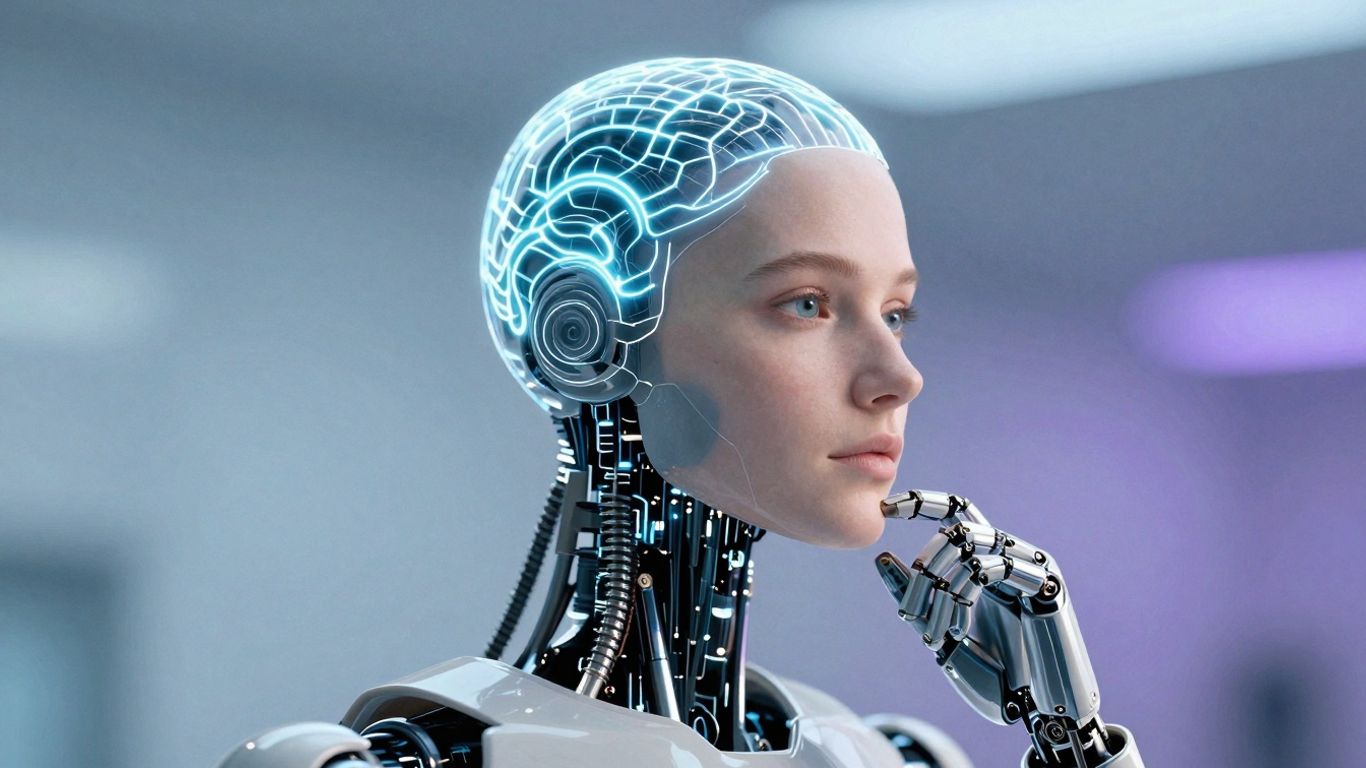
This is where things get really interesting, and honestly, a bit sci-fi. Self-aware AI is the pinnacle, the ultimate goal for some researchers, and the stuff of many a movie plot. It’s about an AI that doesn’t just do things, but actually knows it’s doing them.
Think about it: an AI that understands its own existence, its place in the world, and its own internal workings. It’s not just processing data; it’s reflecting on that processing.
This kind of AI would have a sense of self, recognizing its own strengths and weaknesses. It could understand its objectives and adapt to new situations not just because it’s programmed to, but because it understands the need to. This level of consciousness is what separates a tool from something that might, one day, be considered a peer.
There are a couple of ways folks are thinking about this:
- Introspective Self-Awareness: This is like an AI looking in the mirror. It can examine its own processes – how it learned something, why it made a certain decision, how much memory it’s using. It’s about internal monitoring and self-assessment.
- Social Self-Awareness: This is about an AI understanding its interactions with others, especially humans. It would grasp social cues, intentions, and emotions, allowing for more nuanced and empathetic communication.
Developing this is, as you can imagine, incredibly complex. We’re talking about AI that can genuinely understand and respond to human emotions, not just mimic them. It’s a fascinating area, and a growing body of evidence suggests that frontier AIs may be conscious, making this possibility no longer something we can just dismiss [3321].
The journey to self-aware AI is as much a philosophical exploration as it is a technological one. It forces us to question what consciousness truly means and whether it’s exclusive to biological life. The ethical implications are enormous, and we’re only just beginning to scratch the surface of what this could mean for our future.
Artificial General Intelligence (AGI)
Artificial General Intelligence, or AGI, is the kind of AI you often see in science fiction movies. It’s about creating machines that can think, learn, and understand just like a human being. This isn’t about a machine that’s good at just one thing, like playing chess or recognizing faces. AGI would be able to tackle any intellectual task that a person can.
Think about it: a human can learn to cook, then learn to drive, then learn a new language, and then figure out how to fix a leaky faucet. AGI would have that same kind of flexibility. It wouldn’t need to be specifically programmed for every single new problem it encounters. Instead, it could use its general intelligence to figure things out.
This is a big leap from the AI we have today, which is mostly ‘narrow’ AI. Narrow AI is fantastic at its specific job, but it can’t do much else. AGI, on the other hand, would possess a broad range of cognitive abilities.
Here are some of the key characteristics we’d expect from AGI:
- Reasoning: The ability to logically deduce conclusions from information.
- Problem-solving: Figuring out solutions to new and complex challenges.
- Learning: Acquiring new knowledge and skills from experience.
- Planning: Setting goals and devising steps to achieve them.
- Abstract thinking: Understanding concepts that aren’t tied to specific examples.
Developing AGI is a massive undertaking, and honestly, we’re not quite there yet. It’s a long-term goal for many researchers. The idea is that AGI could help us solve some of the world’s biggest problems, but it also brings up a lot of questions about safety and control.
The pursuit of AGI represents a quest to replicate human-level cognitive abilities in machines. It’s a theoretical benchmark that, if achieved, would fundamentally change our relationship with technology and the world around us. The challenges are immense, spanning not just computational power but also a deep understanding of consciousness and intelligence itself.
Machine Learning
So, what exactly is machine learning? Think of it as teaching computers to learn from experience, kind of like how we humans do, but without us having to spell out every single little step. Instead of writing super specific instructions for every possible situation, we give the computer a bunch of data and let it figure out the patterns and rules on its own.
It’s all about algorithms that can sift through massive amounts of information, spot trends, and then use those trends to make predictions or decisions.
This learning process usually involves a few key stages:
- Data Input: Feeding the system a large dataset relevant to the task.
- Pattern Recognition: The algorithm analyzes the data to find recurring themes or relationships.
- Model Training: The algorithm adjusts its internal parameters based on the identified patterns.
- Prediction/Decision: Using the trained model to make informed guesses or choices on new, unseen data.
The core idea is that the more data a machine learning model processes, the better it gets at its assigned task. It’s this ability to adapt and improve over time that makes it so powerful.
We see machine learning everywhere, even if we don’t always realize it. When your email filters out spam, that’s machine learning at work. When a streaming service suggests a movie you might like based on what you’ve watched before, that’s machine learning too.
Even in more complex areas like medical diagnosis or financial fraud detection, machine learning algorithms are helping to identify subtle clues that humans might miss.
Machine learning isn’t magic; it’s a sophisticated process of statistical analysis and pattern identification. The ‘learning’ comes from the algorithm’s ability to refine its own performance based on the data it encounters, leading to increasingly accurate outcomes without direct human reprogramming for every new scenario.
Deep Learning
Deep learning is a really interesting part of AI, kind of like a more advanced version of machine learning. Instead of just learning from data, it uses structures that are loosely based on how our brains work – these are called neural networks.
Think of them as layers of interconnected nodes, where each layer processes information and passes it along to the next. This layered approach lets deep learning systems tackle really complex problems.
The power of deep learning really shines when dealing with messy, unstructured data like images, sounds, or text. It can figure out patterns in this kind of data that simpler methods might miss.
For example, it’s what allows your phone to recognize your face or a program to understand what you’re saying to a voice assistant.
Here’s a simplified look at how it generally works:
- Input Layer: This is where the raw data, like pixels in an image or words in a sentence, first enters the network.
- Hidden Layers: These are the middle layers where the actual processing happens. Each layer extracts different features from the data. Early layers might detect simple things like edges in an image, while later layers combine these to recognize more complex shapes or objects.
- Output Layer: This layer gives you the final result, like identifying an object in a photo or translating a sentence.
Because these networks have so many layers, they’re called “deep.” This depth allows them to learn incredibly intricate patterns. It’s a bit like how we learn – we build up understanding from simple observations to more complex concepts.
While deep learning is super powerful, it needs a lot of data to learn effectively. The more examples you give it, the better it gets at recognizing patterns and making accurate predictions. It’s like practicing a skill over and over; the repetition helps you improve.
This technology is behind a lot of the AI advancements we see today, from better recommendation systems to more sophisticated medical diagnoses. It’s a big reason why AI feels like it’s progressing so quickly.
Natural Language Processing (NLP)
Natural Language Processing, or NLP for short, is all about teaching computers to understand and work with human language.
Think about it – we humans use words, both spoken and written, to communicate pretty much everything. NLP is the branch of AI that tries to make machines get what we’re saying, and even respond in a way that makes sense to us.
It’s the technology behind many of the AI tools we use every day. Ever asked Siri or Alexa a question? That’s NLP at work. Chatbots that answer your questions on a website? Yep, NLP again. Even when Google Translate converts one language to another, it’s using NLP to figure out the meaning.
Here’s a quick look at what NLP helps AI do:
- Understanding Text: Figuring out the meaning, sentiment (is it positive or negative?), and key topics in written documents.
- Understanding Speech: Converting spoken words into text that a computer can process.
- Generating Text: Creating human-like text, whether it’s a summary, an answer to a question, or even a creative story.
- Translating Languages: Moving text or speech from one language to another.
NLP systems analyze language by breaking it down into smaller parts, looking for patterns, and using that information to perform a task. It’s like learning grammar and vocabulary, but for a machine.
This field is constantly getting better, allowing AI to interact with us more naturally and perform increasingly complex language-related tasks. It’s a pretty big deal for making AI more accessible and useful.
Wrapping Up Our AI Exploration
So, we’ve taken a look at the different kinds of AI out there. It’s pretty wild how much this technology is already part of our lives, from the phones in our pockets to the cars on the road.
Knowing the difference between the simple AI that just does one thing and the more complex ideas we’re still working on helps us see what AI can do and where it’s headed.
It’s not magic, just clever programming and a lot of data. As AI keeps changing, understanding these basic types is a good way to keep up with it all.
Frequently Asked Questions
What’s the main difference between the AI types that only do one thing and the ones that can do many things?
Think of it like tools! The AI that can only do one thing is like a hammer – great for nails, but useless for cutting wood. This is called ‘Narrow AI.’ The AI that can do many things, like a super-smart assistant, is called ‘General AI.’ We don’t have that kind of AI yet, but scientists are working on it!
Are self-driving cars considered ‘smart’ AI?
Yes! Self-driving cars use a type of AI called ‘Narrow AI.’ They are really good at the specific job of driving, like spotting other cars, reading signs, and staying in their lane. But they can’t suddenly decide to write a poem or play chess.
What does ‘Limited Memory’ AI mean?
This type of AI can remember things from the past for a short while to help it make better decisions. For example, when you talk to a virtual assistant like Siri or Alexa, it might remember what you just asked to give you a more helpful answer. It’s like having a short-term memory.
Will AI ever be able to feel emotions like humans do?
That’s a big question! AI that can understand human emotions is called ‘Theory of Mind’ AI, and it’s still being developed. AI that can actually *feel* emotions like humans is called ‘Self-Aware AI,’ and that’s even further away and a topic of much debate.
Is ‘Artificial General Intelligence’ (AGI) the same as ‘Strong AI’?
Yes, they are basically the same idea! Both AGI and Strong AI refer to the goal of creating AI that can think, learn, and solve problems just like a human can, across many different tasks and situations.
How does AI learn?
A lot of AI learns through something called ‘Machine Learning.’ Imagine teaching a computer by showing it tons of examples, like pictures of cats. After seeing enough pictures, it learns to recognize a cat on its own, without you having to tell it exactly what to look for each time.